Upbound
AI
Platform Engineering
Upbound v3 is what enterprises have been missing. One view of everything you run, one API to ask it through, and one governance model no matter where each control plane is deployed. Engineers, pipelines, and agents work through the same path and under the same rules, so you can let an agent provision infrastructure without a separate governance regime, and still answer an auditor about who or what it did.
The infrastructure platform that runs itself.
No enterprise has a unified API and governance model across all of its control planes. Each one manages its own corner, split across business units, clouds, data centers, and whatever tooling each team standardized on. Nothing sees or governs them all. Platform engineers bridge that gap manually, moving between Git, cloud consoles, pipelines, and wikis. It works until it doesn't. The moment a CVE drops, the first question is which control planes are running the affected package, and answering it takes an afternoon of scripting instead of one query.
A control plane closes part of that gap. Each one continuously checks what you declared against what is actually running and fixes the difference, without waiting for a person to notice and file a ticket. But no control plane knows what the others are doing. The hyperscalers solved that inside their own clouds, wiring their control planes together so the fleet operated without humans in the loop. Enterprises need the same speed, visibility, and governance as the hyperscalers, across the infrastructure they own and the clouds they rent. Now that infrastructure-hungry agents are in the mix, no team can govern one system at a time and keep pace.
And because everything runs through that one path, the platform holds the history of how your estate actually behaves, not just its current state. A single control plane reconciles itself without waiting for a person to notice. Upbound v3 does that for the fleet: policy enforced where the change happens, credentials rotated without anyone handling them, drift closed as it appears, and the record written whether or not anyone is watching. No human has to be in the loop for any of it. That is what it means for a platform to run itself.
Upbound builds on Crossplane, which became a CNCF Graduated project in 2025, has passed 100 million downloads, and runs in production at more than 1,000 organizations including Apple, Nike, JPMC, Elastic, Grafana, and Akamai.
What’s new in Upbound V3:
Same platform for every user
Software and agents come in through Hub. Humans come in through Console. Automation and CI come in through Up CLI. All three read the same estate.
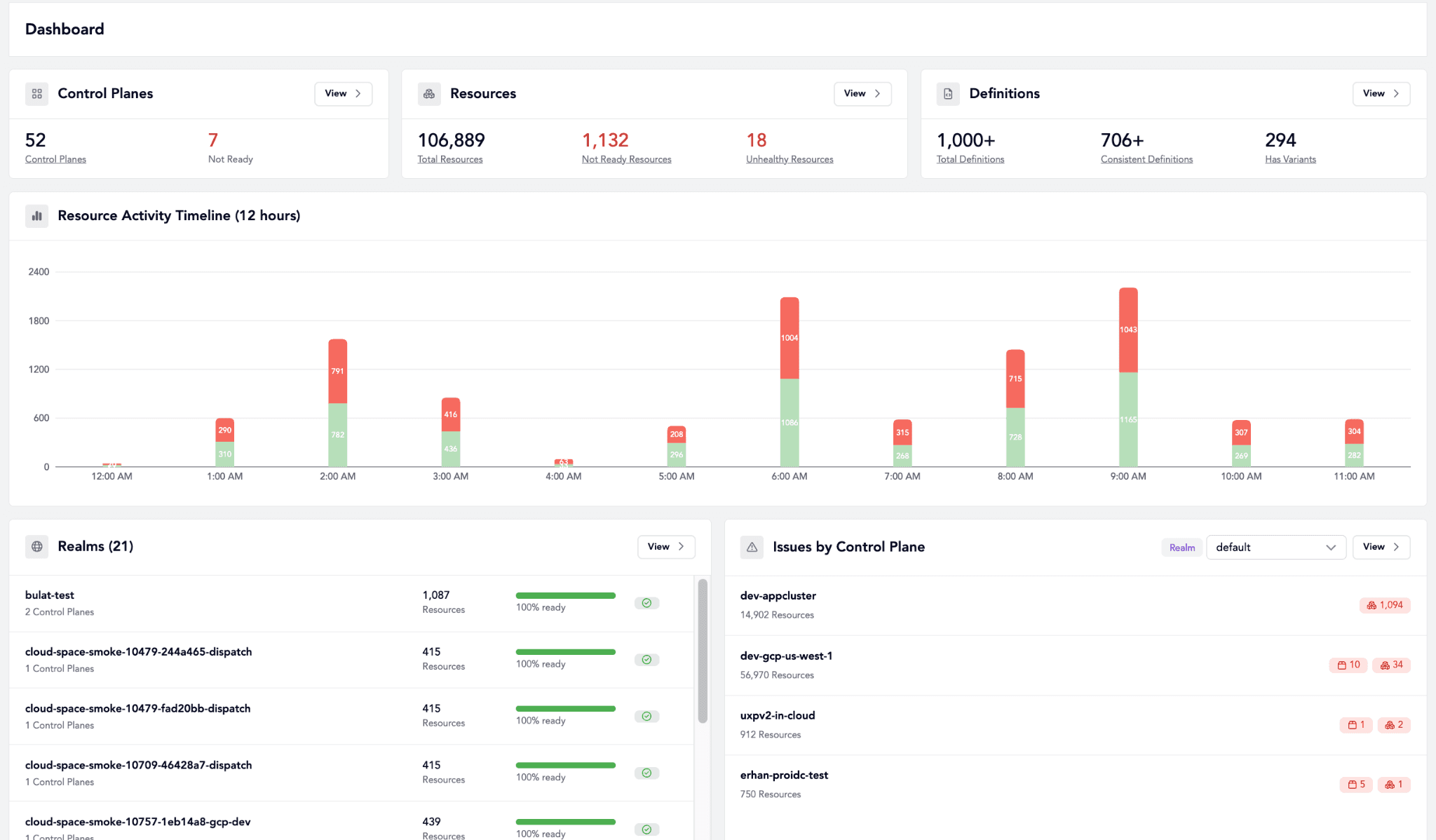
Hub is the unified API across your control plane fleet. It indexes resources across every control plane you operate, so you ask once what exists and what state it is in. Platform teams' tooling no longer needs a hardcoded list, and a developer portal or compliance check picks up new control planes as they come online. An agent can find out what exists before it acts.
Console is the web interface where humans operate the platform and every product on it.
Up CLI is the terminal and pipeline path, through the same API. A script sees exactly what a person sees.
"AI is changing not only how software gets built, but who operates the infrastructure underneath it. Platform teams need one platform for their whole fleet, whether the work is done by a person, a pipeline or an agent." - Bassam Tabbara, CEO and Founder, Upbound
One governed fleet
Every control plane comes with its own login, its own roles, and its own secrets. At 5 you can hold that in your head. At 50, nobody can answer who has access to what without assembling it manually, and that is the first thing an auditor asks for.
Identity gives you one access model across everything you run. Single sign-on, role-based permissions applied fleet-wide, and centrally managed credentials distributed by label and rotated automatically. Fleet management is what turns a mixed estate into a single fleet, operated together rather than as separate populations.
The same model covers AI, and it goes further than parity with a person. An agent can be scoped more tightly than any human role you would bother to create. Read-only across the whole fleet, or write access to a single namespace in a single control plane, issued for as long as the task runs. An agent requesting infrastructure is subject to the same policy as a person. It authenticates, it is scoped, its actions are recorded, and it never sees credentials in plaintext.
A guardrail written into a prompt is not a boundary, it is an instruction. An agent can be argued out of an instruction. Identity does not depend on the model behaving, because the policy is enforced where the change happens and the record is written whether or not anyone was watching. Governance becomes a boundary every change passes through.
In our own fleet audit before launch, the agent held one Identity-issued, read-only, fleet-scoped token. It had no kubectl context into any of the 24 control planes it reported on, and every call it made is in the audit record.
"As organizations introduce AI agents into infrastructure operations, having consistent visibility, access controls and governance across environments is becoming increasingly important." - Matthew Flug, Research Manager, Intelligent Application Modernization and Deployment Platforms, IDC
Secure supply chain
Marketplace shows per-version CVE summaries and downloadable SBOMs before you install, with a private registry for internal packages. Official and partner images ship signed and SLSA Level 2, with backported patches and a defined support window.
For what is already running, Marketplace tells you an advisory applies and Hub tells you how far it reaches: which control planes, at what digest, and how widely.
Runs anywhere
Regulated and air-gapped business units usually get a reduced version of whatever everyone else runs, so the estate under the most scrutiny ends up with the least visibility. In Upbound V3, self-hosting covers the entire platform, Console included, and extends to fully air-gapped deployments with no connection out. The same capabilities and the same governance apply whether you run in the cloud, on prem, or behind an air gap.

One platform. Two products.
Upbound Control Plane runs, operates, and governs control planes on your behalf, including lifecycle, networking, and day-two operations. v3 adds cross-region disaster recovery and scheduled DR exercises per control plane, so the cluster is no longer the unit of failure. Grupo Boticário cut DevOps engineering costs by 98% by handing that work to Upbound.
Upbound Insights is new in v3. It gives you a live view of what is running across your estate, both what Upbound Control Plane manages and what sits in the Kubernetes clusters below it. Insights is the signal and Hub is where you resolve it. In our own estate, 230 out-of-sync resources turned out to be 11 root causes.
Get started
Upbound v3 is available today.
About Authors
Upbound